Author: Mika Wenell

  • If They Don’t Buy Yet, It May Not Be About Price

    If They Don’t Buy Yet, It May Not Be About Price

    Sharing is caring:

    Many innovative products sell slowly because customers are not ready for the new way of working.

    They may first need to understand what is changing, what matters and how to make the change successfully.

    Instead of pushing them to buy, help them become ready.

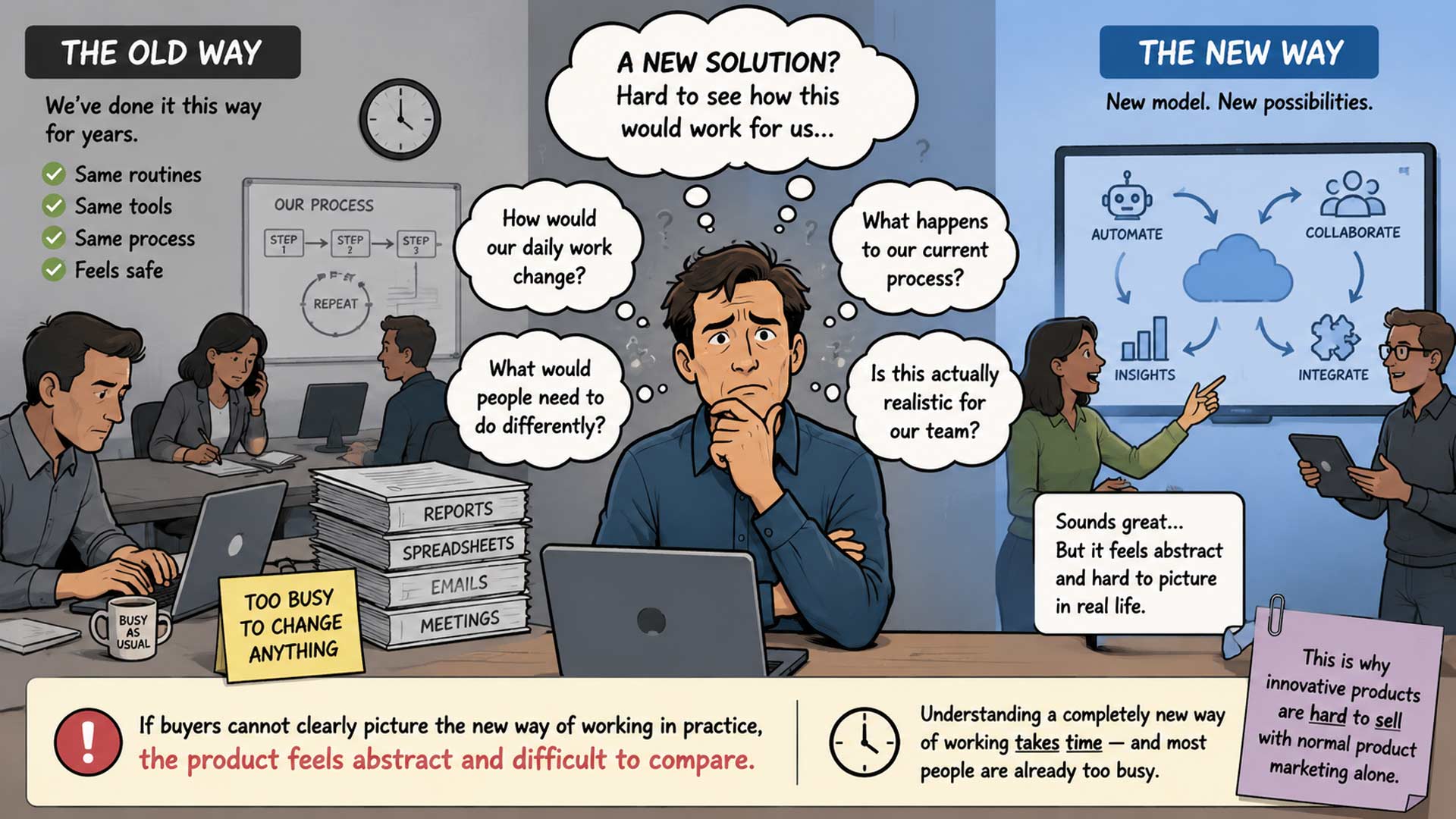
    They don’t understand the new way of working
    Digital comic-style illustration showing why innovative products are often difficult for customers to adopt. The image is divided into two sides: “The Old Way” and “The New Way.” On the left, office workers follow familiar routines with paperwork, spreadsheets, emails, and meetings, representing established workflows repeated for years. On the right, a modern digital system with automation, cloud workflows, analytics, and collaboration tools represents a new operational model. In the center, a confused business professional sits at a laptop surrounded by thought bubbles asking questions such as “How would our daily work change?” and “Is this realistic for our team?” Sticky notes and text highlight that people are often too busy to learn completely new ways of working, making innovative products feel abstract and difficult to compare.
    Customers may understand your product but still struggle to picture how their daily work would change. If the new way of working feels unclear, adopting your solution feels difficult.

    Too Many Choices and Too Much Information
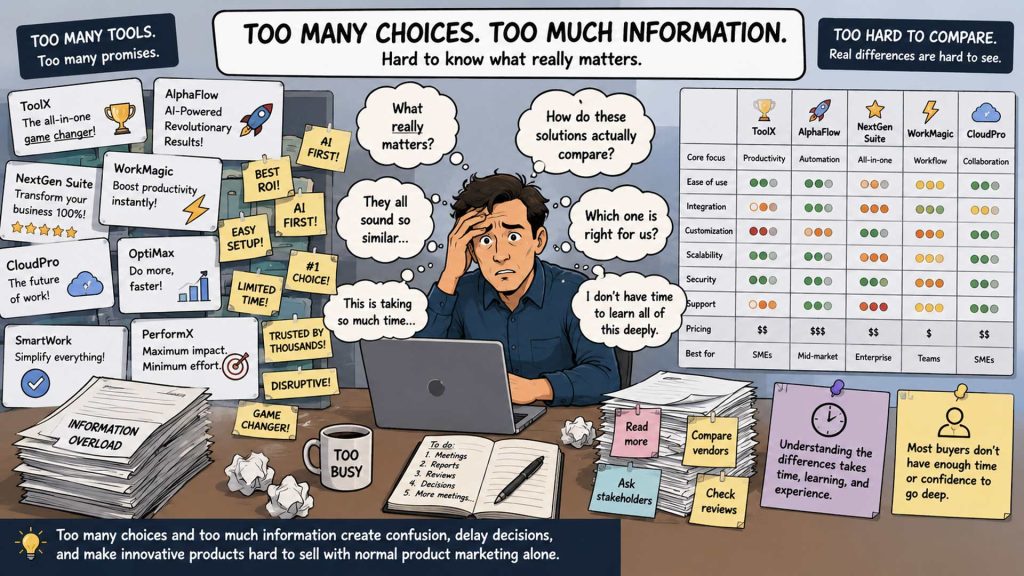
    Digital comic-style illustration showing a stressed business buyer overwhelmed by too many software choices and too much information. In the center, a worried office worker sits at a laptop surrounded by floating marketing messages, comparison charts, sticky notes, piles of papers, and many different software brand cards. Thought bubbles around the person ask questions like “Which one is right for us?” and “How do these solutions actually compare?” The image highlights confusion, information overload, lack of time, and difficulty understanding the real differences between new solutions. A large comparison table on the right shows many similar-looking products with different ratings and features, while notes and papers around the desk emphasize how hard and time-consuming it is for buyers to evaluate innovative products.
    When the whole area is new, products and promises can look similar. Customers don’t yet know what really matters or how to compare the alternatives.

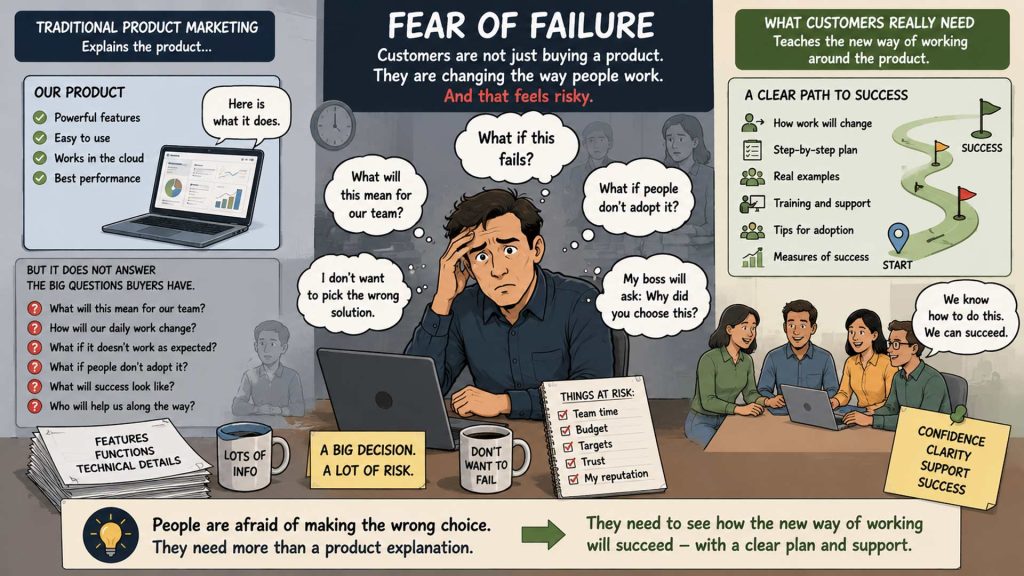
    The Change Feels Risky

    Digital comic-style illustration about fear of failure when buying new business solutions. In the center, a worried office worker sits at a desk with a laptop, holding their head while thinking about risks and possible failure. Thought bubbles around the person contain questions like “What if this fails?”, “What if people don’t adopt it?”, and “What will this mean for our team?” On the left side, traditional product marketing is shown with a software screen, feature lists, technical details, and papers, but it does not answer practical questions about how work will change. On the right side, a more supportive approach shows a clear path to success with training, step-by-step guidance, teamwork, support, and examples of how the new way of working can succeed in real life. The overall image shows that buyers are not only choosing software — they are worried about changing how people work.
    Customers aren’t only buying a product. They may be changing processes, routines and how people work. Choosing the wrong solution can therefore feel risky.

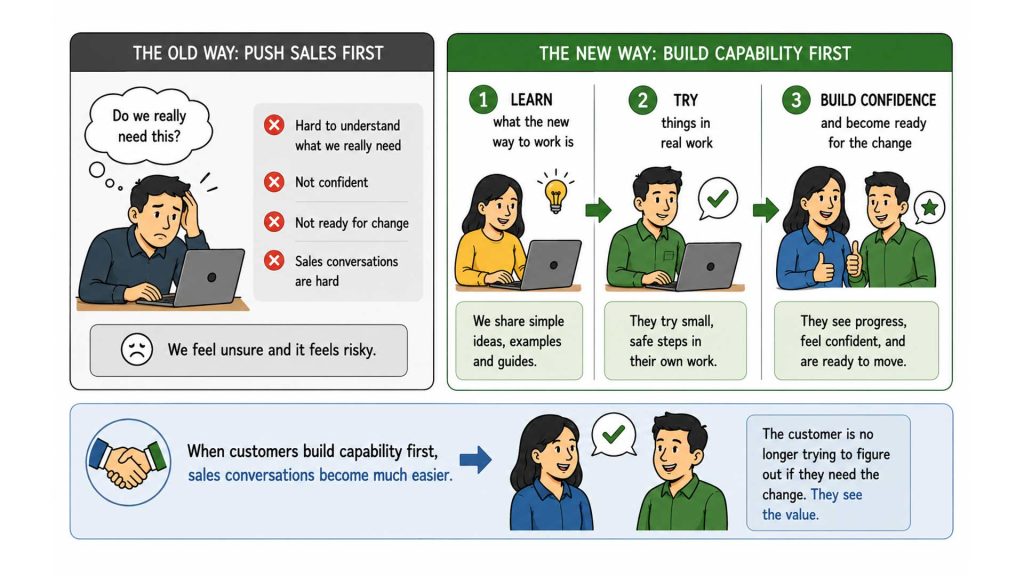
    Sales via Capability Building

    Digital comic-style infographic comparing two ways of selling new solutions. On the left side, labeled “The Old Way: Push Sales First,” a stressed office worker sits at a laptop looking worried and uncertain. A thought bubble asks, “Do we really need this?” Next to the person is a list of problems such as “Hard to understand what we really need,” “Not confident,” “Not ready for change,” and “Sales conversations are hard.” A message at the bottom says, “We feel unsure and it feels risky.”

On the right side, labeled “The New Way: Build Capability First,” the process is shown in three simple steps. Step 1 shows a person learning the new way of working with examples and guides. Step 2 shows a person trying small steps in real work on a laptop. Step 3 shows two happy people building confidence and becoming ready for change. Arrows connect the steps to show progress.

At the bottom of the image, two people have a positive conversation with check marks above them. Text explains that when cus

    Instead of pushing customers to buy before they are ready, help them understand and adopt the new way of working.

    Learn → Build capability → Become ready to buy

    When customers understand the change and feel confident about it, the sales conversation becomes much easier.

    And this is exactly where the sponsorship concept can enter.

    Give Them Something That Helps Them Get Ready

    Give your future customers access to a learning and insight service as a gift.

    With Ahead, your company can sponsor Premium access for customers and prospects.

    1. You give them something useful.
    2. They build capability.
    3. You stay connected while they become ready.

    Book a Free Strategy Session

    In a short strategy session, we evaluate whether your CRM, product, and customer journey are suitable for customer-funded capability transformation.

    We’ll discuss:

    • operational fit
    • customer readiness gaps
    • transformation potential
    • possible monetization models
    Image of Mika Wenell

    Mika Wenell
    +358 40 173 7211
    Founder, Uniwaves Oy
    LinkedIn

    Contact Form

    Send a message to Mika

    Learn more

    Sharing is caring: